
Drill Log Digitisation
Unlock valuable geological information hidden within historical drill reports and archives, transforming legacy records into analysis-ready datasets that support faster, more informed exploration decisions.

Unlock the Value Hidden in Historical Drill Records
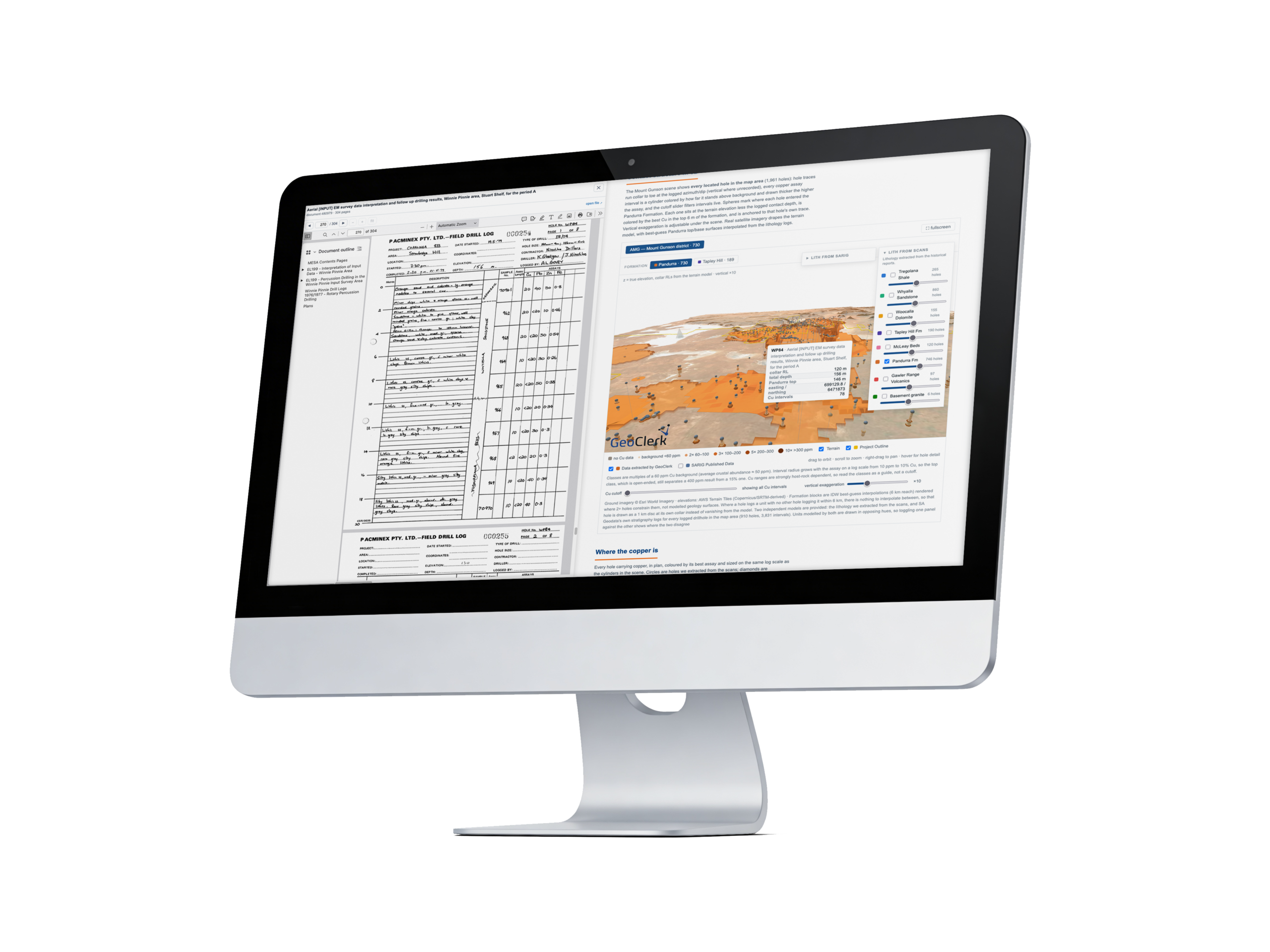
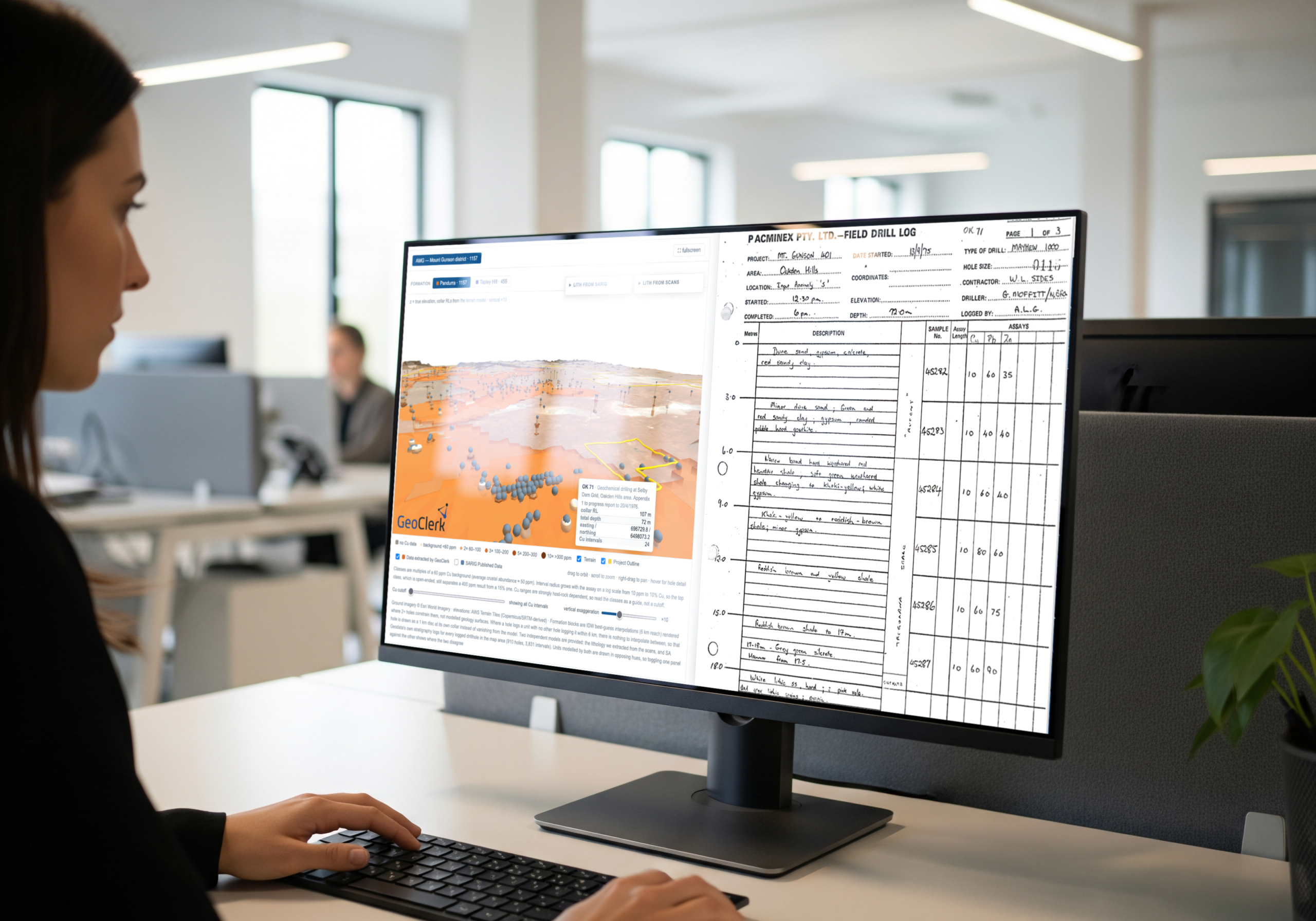
Decades of exploration data remain trapped inside scanned reports, handwritten logs, government submissions and legacy company archives. GeoClerk’s Historical Drill Log Recovery service transforms these documents into structured, searchable datasets that can be integrated directly into modern exploration workflows.
Recover collar locations, surveys, lithology, assays and geological observations while maintaining complete traceability back to the original source document.
Turn historical reports into a strategic asset.
Valuable Data Often Remains Out of Reach
Mining companies have invested millions of dollars in drilling programmes over the past decades. Yet much of the resulting information remains locked within scanned PDFs, historical reports and paper-based archives, making it difficult to search, analyse or incorporate into modern geological databases.
As projects change ownership and datasets become fragmented, valuable geological knowledge can be overlooked or lost entirely. Exploration teams are left working with incomplete information despite the answers potentially already existing within historical records.
Recover and Structure Historical Exploration Data
GeoClerk combines advanced AI-powered extraction, geoscience expertise and rigorous quality assurance to recover geological information from historical drilling records and convert it into structured digital datasets ready for interpretation and analysis.
Every recovered value is independently validated and linked directly to its original source page, providing complete transparency and confidence in the recovered data.
What We Recover
Collars & Surveys
Recover collar coordinates and downhole survey data from reports, maps, public registers and local mine grids.
Assays & Geochemistry
Extract assay tables, intervals and geochemical results from historical reports and appendices.
Lithology & Formation Contacts
Digitise lithological descriptions, formation picks and geological observations from legacy drilling records.
Hole Identity Resolution
Identify duplicate, split and corrupted drillhole identifiers while preserving original references and audit trails.
Maps & Supporting Documentation
Capture valuable information hidden within plans, sections, figures and supporting exploration documents.
Why Historical Drill Log Recovery Matters?
Unlock Hidden Value
Extract information that has remained inaccessible inside historical document archives for years.
Recover Lost Geological Knowledge
Bring legacy exploration insights back into active decision-making processes.
Improve Data Coverage
Create more complete geological datasets by incorporating previously unavailable information.
Accelerate Target Generation
Identify overlooked opportunities using richer and more comprehensive datasets.
Support Project Reviews and Acquisitions
Quickly assess the true value of historical exploration assets during due diligence activities.
Strengthen Geological Models
Improve interpretation confidence by expanding available drilling and geological information.
Maintain Full Traceability
Every recovered value remains linked to its original source document and page.
Reduce Time to Insight
That gives you a nice balance between commercial, technical and operational benefits.
Proven Results
Case Study: Stuart Shelf, South Australia
GeoClerk’s Historical Drill Log Recovery service has already demonstrated its ability to unlock significant value from legacy exploration archives. In one project across the Stuart Shelf in South Australia, a historical drilling programme was recovered end-to-end over a 15,700 km² project area. The project involved reviewing more than 40,000 pages of historical reports, resulting in the recovery of 7,310 drillhole records and the extraction of over 159,000 assay records. GeoClerk also recovered 2,053 collar locations where source documents contained no usable coordinates, helping to rebuild critical components of the historical dataset.
The project also highlighted how much valuable exploration information can remain absent from public databases. GeoClerk identified 212 sites containing recovered geochemical data that was not available through the state register and recovered a further 9,793 assay results from just 34 historical reports. These findings demonstrate the potential for historical document archives to contain substantial geological information that can strengthen interpretations, support project evaluations and reveal new exploration opportunities.
What next?
Turn Historical Reports into a Stratefic Asset
GeoClerk is a B2B subscription product. To arrange a free trial or discuss access for your organisation, contact [email protected].